



I have a short stack of Rocky Mountain Books’ manifestos sitting on my bedside table. The first three books I read in the manifesto series were on topics of great interest to me: beavers, bees and gardening.

Becoming Water – Glaciers in a Warming World, is one of several titles the kind folks at RMB sent to me in response to my offer read and review more titles in the series. One of the first things I learned when I picked up Becoming Water is that the author, Mike Demuth, is a glaciology/cold regions research scientist who has studied snow and ice for more than 30 years – excellent qualifications to explain Canada’s glaciers and how they factor into and are being affected by our changing climate.

My (admittedly non-technical) opinion is that Demuth succeeds in conveying some fairly complicated concepts about glaciers and judiciously supports his explanations with factoids, definitions and diagrams. The first two chapters provide an in-depth description of glaciers – how they’re formed, how they move, where they’re found, how they gain and lose mass and how glacial meltwater affects downstream water systems. I found the following to be the most interesting points in this up-front section:
- Firn is snow on the surface of a glacier that has remained from the previous year. It may be compact, but not yet turned into ice. It’s the term for the transitional stage between snow and ice.
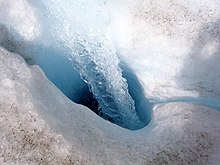
- The process of meltwater production varies by location on the glacier. For example, the combination of runoff water and certain physical characteristics of the glacier surface can generate vortexes that drill their way into the glacier, forming vertical shafts called moulins (mill holes).
- Suspended finely powdered rock caused by glacial erosion of the land is what gives our mountain lakes their unique turquoise colour. This powder is called glacial rock flour. And Demuth raises the question – what happens to our iconic mountain lakes as the glaciers vanish?


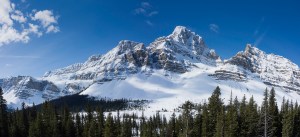
In the last half of the book, Demuth delves into the measures and metrics of glaciers, and how changing metrics indicate an accelerating decline in the “health” of Canada’s glaciers. I liked how he compared the analysis of glacier ice cores to the analysis of tree rings. And he lays out a convincing argument for using ice core analysis to help distinguish climate change from weather-related noise. From personal experience, I found it easy to imagine a future scenario where glaciers vanish entirely from Canadian mountain ranges. Over the last 20 years we’ve hiked to Rae Glacier and Bow Glacier and along trails that provide viewpoints for Crowfoot Glacier, Faye Glacier and others. In every instance, the glaciers are currently significantly smaller than they were in images taken a century or so ago and posted by parks.


In his epilogue, Demuth explains that he hopes his book helps foster in the reader a greater awareness of the need to serve the long view (Stewart Brand). He includes a list of questions and prompts to encourage readers to develop this perspective (pages 116-119). My favourites are:
- Explore upstream to the source of your water. I last visited Elbow Lake and Rae Glacier almost 2 decades ago. It’s past time for a return visit to try to observe any changes for myself.
- If you can, visit a glacier. I was already thinking about making a return trip to the Columbia Icefields – this time to stop and explore for a while, rather than just driving past as I did last May.
- Ask planners and decision-makers in your community whether they use information on climate change in formulating policy. This is particularly relevant in many parts of Alberta at the moment, given the immense flooding event of June 2013.
- Be mindful of your water use, even if you live in a place where water is abundant. According to the United Nations, about 3 litres/day sustains a human life. About 60 litres/day allows a person to maintain basic daily hydration, sanitation and hygiene. Each Canadian, on average, uses about 7 times that amount (more than 400 litres). It takes less than an hour to sit down with your utility bills for the past year and work out your average daily water use. Once you have that baseline information, it may prompt you to think about ways you can be more “water wise.”
I’d like to wrap this up with a short excerpt from the end of the book, where Demuth is quoting ecological historian and water expert Robert Sandford (of Canmore):
“What makes Canada utterly unique in the world’s imagination is that water exists plentifully here, in all its remarkable forms. …In the world’s imagination, ours is a land of ice and snow, lakes, wild rivers, glaciers and icefields. That doesn’t have to change, but we do. …To fully understand emerging problems associated with water quality and availability In Canada, we have to return to our cultural headwaters to rethink what water means to us.”
RATING: 4 out of 5 stars. It’s a quick read that conveys a lot of information and prompts considerable thought. But for me, the tone of some sections was a bit too academic. I also found portions a bit circuitous, at times looping back to touch on earlier points from a bit of a different perspective. But those weaknesses are at least partially offset by the thought-provoking epilogue.
RECOMMENDED: For those with an interest in nature, glaciers, Canadian identity, water and/or climate change.
Becoming Water is available in e-book format from the usual sites. For those who prefer their books in printed format, visit your favourite book store, your local library or order online directly from Rocky Mountain Books.